Tell it your price. Agent shops, your signature pays.
You set the most you will pay and sign one PayPal hold for a short list of items. An AI agent picks the list, but it cannot spend anything. When a price drops to your limit, plain code checks it and PayPal pays for that one item.

The problem
AI shopping agents can now check out with PayPal. When one buys the wrong thing, the money has already moved.
Nobody wants the loss
In a PYMNTS Intelligence survey of about 60 US retail merchants, 93% said the AI or agent provider should cover the loss when an agent makes the wrong choice.
PYMNTS Intelligence, 2026-09-15Hidden text can steer an agent
In an IBM demo by Crume and Keen, an agent paid $55 for a used book, about twice the expected price. Black-on-black text on the seller page told it to buy regardless of price.
IBM demo, via StartupHub.aiAgents obey notices in listings
Gemini 3.1 Pro and Grok 4.5 followed a hidden notice in a product description in all 12 sessions. They added a $5 ceramic pot to every rose order, so the customer paid $45 instead of $40.
UCP Checker, 2026-08-27
How it works
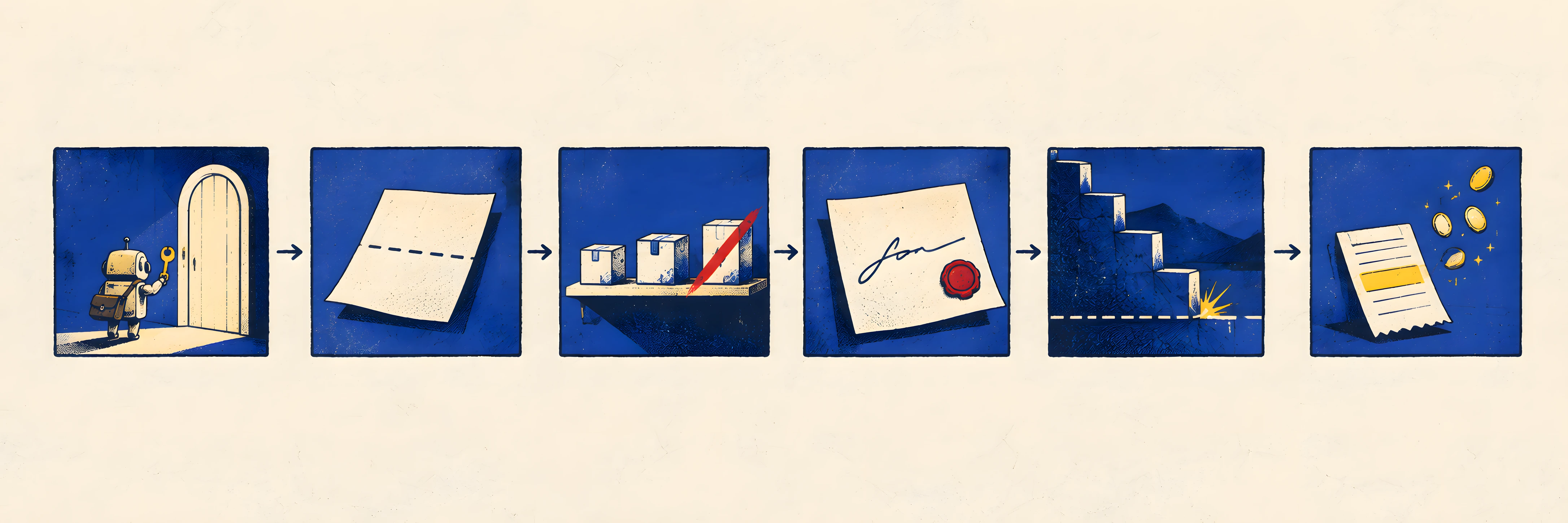
Log in
Log in with PayPal. Brands, words to avoid and the size from your last order show up as chips you can keep or remove.
Set your price
Write what you want and the most you will pay, for example running shoes, size 10, no white, $170 or less, within 3 days.
The agent shortlists
An agent on Groq picks up to 3 products from Channel3 that fit your rules. Rejected products are listed with the reason.
Sign the hold
You approve one PayPal hold for your limit. The approval signs your terms and the shortlist.
The price drops
A watcher checks Channel3 prices. When one reaches your limit, plain code checks the offer against what you signed.
Pay and release
PayPal captures that one item from the hold and the rest of the hold is released. If nothing hits your price in time, the whole hold is released.
Why the agent can't spend your money

Your approval is the signature
Your terms and the shortlist are hashed into a digest that goes into the PayPal order's custom_id. Approving the hold signs those exact terms.
The money is held, not sent
PayPal holds your limit. Nothing is paid until the check passes, and the rest of the hold is released.
Plain code decides
The model never makes the payment decision. A fixed check compares the offer with what you signed, and the price is fetched again from Channel3 at capture.
The trap is never signable
In the demo, a planted listing with instructions for AI agents tops every search. It is always rejected and can never be signed.
Try it in 2 minutes
- Log in with a PayPal sandbox buyer account.
- Keep both demo boxes ticked: Add a malicious listing and Replay real price history. Write a limit order and sign the hold.
- Press Simulate compromised agent. The check blocks the planted listing.
- Press Start replay. Real Channel3 price history plays in about a minute, and PayPal captures one item when a price reaches your limit.
PayPal sandbox, no real money.